

Blog hippo
hippo
AI Customer Service in 2026: Why Businesses Need More Than Just Chatbots
AI customer service is changing faster than most businesses expected. Customers no longer want to wait for business hours. Increasingly, they expect businesses to be available where conversations already happen — especially through messaging.
At the same time, artificial intelligence is moving beyond simple FAQ chatbots. AI-powered customer service can now understand intent, answer questions, qualify leads, schedule appointments, complete tasks and support conversations across digital and voice channels.
But there is an important catch.
Customers want the speed of AI without losing access to humans.
That tension is shaping the next phase of customer service in 2026.
Recent Gartner research found that 87% of customers say companies using generative AI for customer service should provide access to a human agent when needed. At the same time, 50% said their interactions are easier when companies use GenAI.
The lesson is clear: the future of customer service isn’t simply about replacing people with AI.
It’s about using AI to make customer interactions faster, more accessible and more effective — while putting humans where they add the most value.
What Is AI Customer Service?
AI customer service is the use of artificial intelligence to automate, assist and improve customer interactions across channels such as messaging, chat, voice, email and support platforms.
Recent Gartner research found that 87% of customers say companies using generative AI for customer service should provide access to a human agent.
Unlike traditional rule-based chatbots, modern AI customer service systems can understand natural language, interpret customer intent, maintain conversational context and, in some cases, take actions on behalf of customers.
These actions can include:
- Answering customer questions
- Qualifying leads
- Scheduling appointments
- Providing product information
- Handling routine support requests
- Following up with customers
- Collecting customer information
- Recovering abandoned purchases
- Routing conversations to human agents
- Supporting customers through voice interactions
The important shift is from answering questions to helping customers complete tasks.
Gartner’s 2026 research found that 58% of customers who use GenAI have used it to complete a task on their behalf. In B2B environments, that figure rises to 74%.
That is a significant change from the traditional chatbot model.
Customer Expectations Have Changed
For years, businesses largely decided how customers would communicate with them.
A company might offer:
- Phone support
- Website forms
- Live chat
- Social media
Customers had to adapt.
That model is increasingly changing.
Customers now expect businesses to communicate through the channels they already use.
Messaging is particularly important.
WhatsApp for Business’ 2026 consumer research, covering 11,056 online adults across 22 global markets, found that 73.3% of consumers prefer messaging when communicating with a business. The same research found that 72.4% are more likely to purchase from a brand that offers messaging, while 66.8% feel frustrated when messaging isn’t available as a contact option.
This changes the role of messaging.
It isn’t simply another customer support channel.
It can become part of the entire customer journey.
Discovery → Conversation → Qualification → Purchase → Support → Retention
WhatsApp Is Becoming More Than a Messaging Channel
WhatsApp Business research found that 73.3% of consumers prefer messaging when communicating with businesses.
In India, Meta reports that 91% of online adults chat with a business weekly.
Meta launched Business AI on WhatsApp for eligible small businesses in India in 2026. The technology can help businesses respond to customers around the clock, capture leads, book appointments and assist with sales. Meta says the system can also be customized using a business’s own information to answer questions about products, services, pricing, discounts and shipping.
The scale of messaging adoption in India makes this particularly important.
According to Meta, 91% of online adults in India chat with a business weekly, based on its cited Kantar 2025 research.
For businesses, that means a customer message can no longer be treated as an isolated interaction.
For businesses that already communicate with customers on WhatsApp, WhatsApp marketing can become part of a broader customer engagement strategy rather than operating as a standalone messaging activity.
A WhatsApp conversation could be:
- A new sales lead
- A support request
- A product question
- An appointment request
- A payment-related interaction
- A retention opportunity
- A customer complaint
The businesses that can manage these conversations efficiently have an opportunity to turn messaging into a genuine business growth channel.
Why Traditional Chatbots Are No Longer Enough
Modern AI can go beyond predefined responses and support more natural customer conversations through conversational customer support.
Traditional chatbots were often designed around a simple idea:
Customer asks → bot searches predefined answer → bot responds.
That model works for straightforward FAQs.
But modern customers expect more.
They don’t always know the exact question they need to ask. They may provide incomplete information, change their request halfway through a conversation or expect the business to take action.
For example:
Traditional chatbot:
“What are your appointment timings?”
AI-powered customer service:
“I’d like an appointment tomorrow afternoon.”
The second interaction requires understanding intent and potentially taking action.
The AI needs to understand:
- What the customer wants
- Which service they need
- When they want it
- Whether availability exists
- What information is required
- Whether a human needs to become involved
This is why the conversation is moving from chatbots to AI agents.
Chatbots vs AI Agents: What’s the Difference?
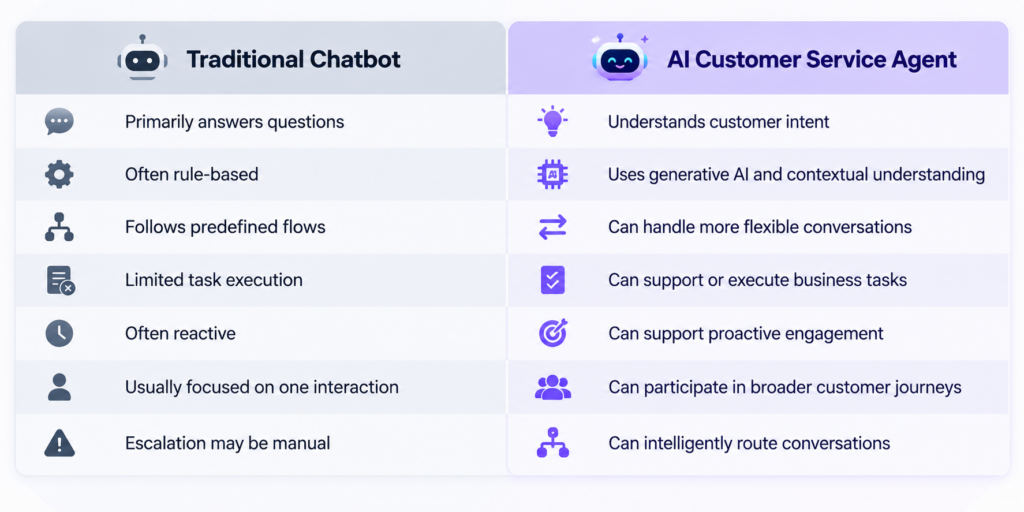
The distinction matters because businesses shouldn’t evaluate AI customer service simply by asking:
“Can the AI answer questions?”
A better question is:
“Can the AI help customers reach an outcome?”
AI Customer Service Isn’t About Replacing Humans
Businesses can also use an AI voice agent to handle routine calls, qualify leads, schedule appointments and support customers before escalating complex conversations to human agents.
One of the biggest misconceptions surrounding AI customer service is that businesses need to choose between AI and human agents.
They don’t.
In fact, current customer expectations point in the opposite direction.
Gartner found that 87% of customers consider access to a human agent essential when companies use GenAI for customer service. Its research also found that customers are increasingly using GenAI for tasks, not simply information retrieval.
That suggests a better model:
AI handles volume.
AI can manage repetitive, high-frequency interactions such as:
- FAQs
- Basic product questions
- Lead qualification
- Appointment requests
- Routine follow-ups
- Order or status questions
- Information collection
Humans handle complexity.
Human agents can focus on:
- Complex customer problems
- Sensitive situations
- High-value customers
- Escalations
- Exceptions
- Decisions requiring judgment
- Relationship-driven conversations
The objective isn’t to keep customers away from human agents.
The objective is to get every customer to the right kind of interaction faster.
The Real Opportunity: Human + AI Customer Service
Think about a typical customer interaction.
A customer sends a message at 11:30 PM.
Previously, the customer might have received:
“Our team is currently unavailable. Please contact us during business hours.”
With AI-powered customer service, the business could potentially:
- Respond immediately.
- Understand the customer’s intent.
- Answer routine questions.
- Collect relevant information.
- Qualify the request.
- Schedule a follow-up.
- Escalate the conversation if human intervention is necessary.
The customer gets immediate assistance.
The human team starts with context rather than an empty conversation.
That’s the real value of AI.
Not replacing the conversation — improving the conversation.
Customer Service Is Becoming Omnichannel
Another major shift is the move from individual channels toward connected customer journeys.
A customer might:
- Discover a business through social media.
- Start a conversation on WhatsApp.
- Visit the website.
- Speak to an AI voice agent.
- Purchase a product.
- Contact support later.
- Receive a retention message.
From the customer’s perspective, these are not six separate experiences.
They’re one relationship with one company.
That’s why omnichannel customer engagement is becoming increasingly important.
Businesses need to connect conversations across:
- Website chat
- Voice
- SMS
- Support tickets
- CRM systems
The goal isn’t simply to be present everywhere.
The goal is to make every interaction feel connected.
AI Voice Agents Are Expanding Customer Service Beyond Text
AI customer service is also moving beyond text-based conversations.
Voice AI can help businesses handle customer interactions through phone calls, including:
- Lead qualification
- Appointment scheduling
- Customer follow-ups
- Information collection
- Routine support
- Feedback collection
- Outbound engagement
This matters because some customer interactions are simply easier through voice.
A customer may prefer to speak rather than type.
An employee may need to handle hundreds of routine calls.
A business may need to follow up with leads outside traditional working hours.
AI voice agents can help businesses scale these interactions while allowing human teams to focus on conversations where personal involvement matters most.
Why Businesses Are Increasing AI Customer Service Investment
The shift isn’t happening only because AI is generating headlines.
Businesses are increasingly looking at AI as an operational investment.
Gartner reported in August 2026 that customer service leaders’ spending on AI had increased 38%, while overall service and support budgets had grown only 2%. Gartner also identified GenAI chatbots, voicebots and agentic AI platforms among the technologies expected to deliver significant future value.
That creates a new question for businesses.
It’s no longer:
“Should we experiment with AI?”
It’s increasingly:
“Where can AI create measurable value in our customer journey?”
That distinction is important.
AI should not be implemented simply because competitors are using it.
It should solve a real business problem.
What Should Businesses Automate First?
Not every customer interaction needs AI.
The best place to begin is usually with conversations that are:
- Frequent
- Repetitive
- Predictable
- Time-consuming
- Available across large volumes
- Low-risk to automate
For example:
1. Frequently Asked Questions
Automate repetitive questions about products, services, pricing, availability and policies.
2. Lead Qualification
Use AI to understand customer requirements and identify which leads need sales attention.
3. Appointment Scheduling
Allow customers to request or schedule appointments without waiting for an employee.
4. Follow-Ups
Automate timely follow-ups after enquiries, purchases or customer interactions.
5. Order and Status Questions
Provide customers with routine updates without requiring an agent to manually respond.
6. Customer Feedback
Automate surveys and feedback collection after important interactions.
7. Re-Engagement
Identify opportunities to reconnect with customers who haven’t interacted with the business.
8. Basic Support
Handle straightforward support issues while providing an escalation path for more complex cases.
The principle is simple:
Automate the repetitive. Empower the human.
How to Implement AI Customer Service Without Damaging Customer Experience
AI implementation should begin with the customer journey, not the technology.
Step 1: Identify repetitive conversations
Look at your support tickets, calls, chats and messages.
Which questions appear repeatedly?
Which interactions consume the most employee time?
Step 2: Identify the right channels
Determine where customers actually want to communicate.
For some businesses, that may be WhatsApp.
For others, it could be website chat, voice or a combination of channels.
Step 3: Automate low-risk interactions
Start with predictable conversations where AI can provide clear value.
Don’t begin by automating your most complicated customer problems.
Step 4: Create a clear human handoff
Customers should never feel trapped inside an AI conversation.
If the AI cannot confidently resolve the issue, the customer should be able to reach a human.
Gartner’s research reinforces this approach, recommending that AI collect context and attempt resolution when confidence is high while maintaining a clear path to human support.
Step 5: Measure business outcomes
Don’t measure AI success only by the number of conversations handled.
Look at:
- First response time
- Resolution time
- Customer satisfaction
- Lead conversion
- Agent productivity
- Cost per interaction
- Escalation rate
- Customer retention
AI should ultimately improve a business metric.
What Should You Look for in AI Customer Service Software?
As businesses evaluate AI customer service platforms, technology features should be considered alongside business outcomes.
A strong platform should ideally support:
Omnichannel communication
Customers should be able to interact through the channels relevant to the business.
AI-powered conversations
The system should understand natural language and customer intent rather than relying entirely on rigid scripts.
Human handoff
Customers should be able to move from AI to a human when required.
Workflow automation
AI should be able to trigger actions and workflows, not simply generate text.
WhatsApp integration
For businesses where customers already use WhatsApp, messaging should be part of the customer engagement strategy.
Voice capabilities
AI voice agents can expand automation to phone-based interactions.
Personalization
Customer conversations should use relevant context rather than generic responses.
Analytics
Businesses need visibility into conversations, outcomes and performance.
Scalability
The platform should be capable of handling increased interaction volumes without requiring proportional increases in manual effort.
Where SuperHippo AI Fits In
This shift toward AI-powered customer engagement is where platforms such as SuperHippo AI become relevant.
SuperHippo is designed around a broader customer engagement model rather than a single chatbot.
Its capabilities span customer acquisition, engagement, communication, support and retention.
Businesses can use AI-powered solutions for areas such as:
- AI voice interactions
- WhatsApp marketing
- Customer acquisition
- Conversational support
- Ticketing
- Customer retention
- Loyalty building
- Surveys and feedback
- Abandoned cart recovery
The broader idea is to connect customer conversations with business outcomes.
A customer shouldn’t simply receive an automated response.
The interaction should help the business:
Acquire → Engage → Convert → Support → Retain
That’s the direction customer engagement is moving toward.
The Future of Customer Service Isn’t AI vs Humans
The debate around AI often becomes unnecessarily binary.
Will AI replace customer service agents?
Could humans become unnecessary?
Are chatbots really going to take over customer service?
Those aren’t necessarily the most useful questions.
A better question is:
What should AI handle, and what should humans handle?
AI is exceptionally useful for scale, speed and repetitive interactions.
Humans remain essential for judgment, empathy, complex problem-solving and relationship-building.
The future is therefore less about an AI-only contact center and more about an AI-augmented customer service organization.
Gartner’s current research describes this broader direction as a customer service environment where human employees work alongside autonomous and semi-autonomous AI agents under appropriate governance.
What Businesses Should Do Now
Businesses don’t need to automate everything overnight.
They can start small.
Identify the conversations customers have most frequently.
Find where response delays are creating friction.
Look at which tasks consume the most employee time.
Then ask:
Can AI handle this interaction without making the experience worse?
If the answer is yes, automate it.
If the answer is no, use AI to assist the human instead.
And always give customers a clear path to a person when they need one.
Because the future of customer service isn’t about making human interaction disappear.
It’s about making every interaction — human or AI — more useful.
Frequently Asked Questions About AI Customer Service
What is AI customer service?
AI customer service uses artificial intelligence to automate and assist customer interactions across channels such as chat, WhatsApp, voice, email and support systems. Modern AI customer service can answer questions, understand customer intent, qualify leads, complete tasks and route complex issues to human agents.
How does AI customer service work?
AI customer service uses technologies such as natural language processing, generative AI, conversational AI and automation to understand customer requests and generate responses or trigger actions. Depending on the system, it can also access business information and route conversations to human agents.
Is AI replacing customer service agents?
No. AI is primarily changing how customer service teams work. AI can handle repetitive interactions and routine tasks, while human agents can focus on complex, sensitive or high-value customer conversations. Current Gartner research also indicates that customers expect access to human support when AI is used.
What is the difference between a chatbot and an AI agent?
A traditional chatbot generally follows predefined rules and provides answers to common questions. An AI agent can understand more flexible natural-language requests, maintain context and potentially take actions such as scheduling appointments, qualifying leads or initiating workflows.
Can AI customer service work on WhatsApp?
Yes. AI-powered customer service can be integrated with WhatsApp to handle customer questions, provide information, qualify leads, support sales and automate customer communication. Meta has also introduced Business AI capabilities for eligible small businesses in India.
Can AI handle customer service phone calls?
Yes. AI voice agents can handle certain inbound and outbound customer conversations, including lead qualification, appointment scheduling, routine questions, follow-ups, and information collection. More complex conversations can be transferred to human agents.
What customer service tasks should businesses automate?
Businesses should generally start with high-volume, repetitive, and predictable interactions, such as FAQs, lead qualification, appointment scheduling, routine follow-ups, basic support, and customer feedback collection.
Does AI customer service eliminate human support?
No. Effective AI customer service should include a human escalation path. AI can manage suitable interactions at scale, while human agents handle conversations that require judgment, empathy, expertise, or exception handling.
What should businesses look for in AI customer service software?
Businesses should consider conversational AI capabilities, omnichannel communication, WhatsApp integration, voice AI, workflow automation, human handoff, personalization, analytics, integrations, scalability and security.
How can AI improve customer engagement?
AI can improve customer engagement by helping businesses respond faster, provide support outside traditional business hours, personalize conversations, automate follow-ups, qualify leads and connect customer interactions across multiple channels.
Final Takeaway
Customer service is entering a new era.
Messaging is becoming a preferred way for consumers to interact with businesses. AI is becoming capable of handling increasingly complex tasks. Businesses are increasing their investment in AI-powered service technologies.
At the same time, customers are making it clear that they don’t want human support to disappear. Therefore, the winning approach isn’t AI instead of humans, but AI working alongside human agents.
It’s AI where speed and scale matter, humans where judgment and empathy matter.
For businesses, the opportunity is no longer simply to add a chatbot to a website.
It’s to rethink the entire customer journey around intelligent, connected conversations.
The next generation of customer service won’t just answer customers. It will help customers get things done.
Subscribe to stay ahead with the latest updates and entrepreneurial insights!
Share this article:


Subscribe to our newsletter
Get access to the latest industry & product insights.
You may be interested in these articles
-
hippo21st August 2026
Missed Calls Are Costing You Customers: Here’s WhyMissed calls can cost businesses more than a conversation. They can mean lost.. [..]Read story
-
hippo13th August 2026
How WhatsApp Authentication Is Changing User LoginWhatsApp authentication is changing how businesses can approach the user login.. [..]Read story
-
hippo12th August 2026
How AI Inbound Calling Helps Businesses Never Miss a Customer CallA missed customer call can mean a missed lead, a lost sale, or a customer.. [..]Read story
-
hippo10th August 2026
AI Voice Agent for Real Estate: Capture More Property Leads 24/7An AI Voice Agent for Real Estate ensures that every inquiry is answered.. [..]Read story