

Blog hippo
hippo
Customer Communication Automation: A Guide for Businesses
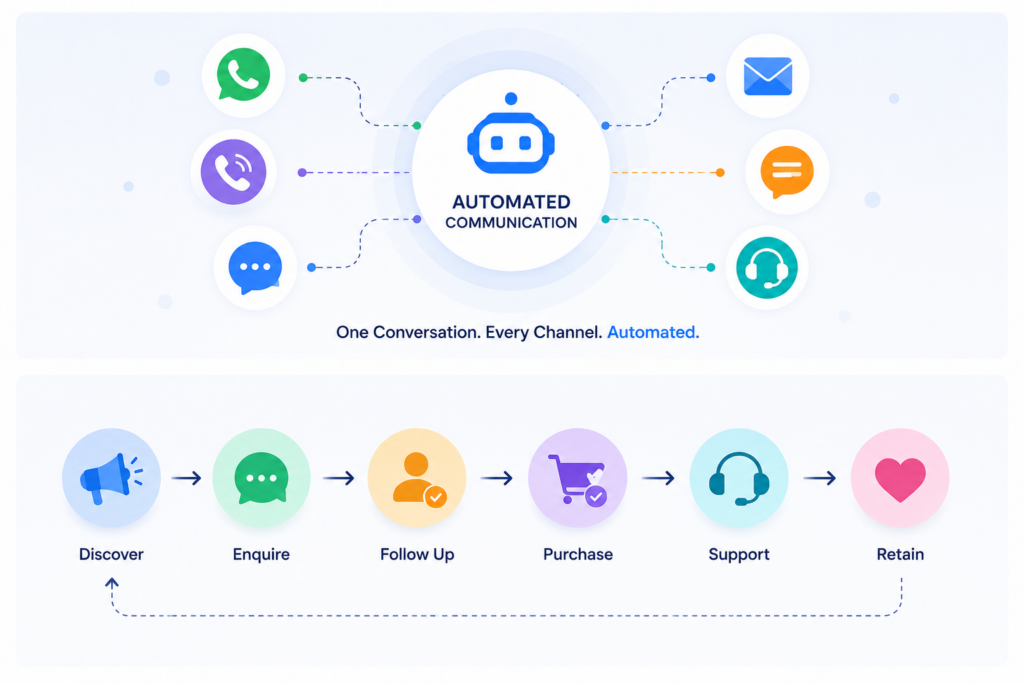
Customer communication automation is changing how businesses interact with customers. Instead of relying entirely on teams to manually respond to every message, call, enquiry, follow-up, and support request, businesses can automate repetitive communication and create faster, more consistent customer experiences.
Customers today expect quick responses and convenient ways to communicate. They may discover a business through an advertisement, ask a question on WhatsApp, receive a follow-up call, make a purchase, and later contact customer support.
For the customer, these aren’t separate interactions.
They are part of one customer journey.
When businesses struggle to manage these conversations efficiently, opportunities can be missed. Customer communication automation helps businesses connect these interactions and make communication more responsive, organized, and scalable.
What Is Customer Communication Automation?
Customer communication automation is the use of technology to automatically manage repetitive and predictable customer interactions across different communication channels.
Instead of manually handling every interaction, businesses can create automated workflows for activities such as:
- Lead follow-ups
- Customer enquiries
- Appointment reminders
- Order updates
- Customer support
- Feedback collection
- Abandoned cart reminders
- Re-engagement campaigns
- Retention communication
The objective isn’t to automate every conversation.
The objective is to automate the right conversations while keeping human teams involved when human judgment is important.
Why Customer Communication Automation Matters for Businesses
Automated customer communication can quickly become difficult to manage as a business grows.
More customers mean more enquiries, more follow-ups, more support requests, and more conversations across different channels.
Without automation, teams may spend a significant amount of time performing repetitive tasks.
This can lead to:
- Delayed responses
- Missed follow-ups
- Lost leads
- Repetitive support work
- Inconsistent communication
- Higher operational workload
- Poor customer experiences
Customer communication automation helps businesses handle high volumes of interactions without requiring every conversation to be managed manually.
How Customer Communication Automation Improves Customer Engagement
Customer engagement often depends on timing.
A potential customer who receives a useful response immediately may continue exploring a product or service. A customer who waits too long may simply move on.
Automated customer communication allows businesses to create timely interactions based on customer actions.
For example:
A customer submits an enquiry → an automated response acknowledges the enquiry → relevant information is shared → a follow-up is triggered → a sales representative takes over when personal assistance is needed.
This creates a more structured customer journey while reducing the amount of manual work required from the team.
Customer Communication Automation Across the Customer Journey
Customer communication automation isn’t limited to one stage of the customer journey.
It can support businesses from the first interaction through long-term retention.
Automated Customer Communication for Lead Acquisition
When a potential customer interacts with a business, automation can help acknowledge the enquiry and begin the next step in the customer journey.
This can help businesses respond consistently instead of leaving new enquiries waiting for manual follow-up.
To Know more about it –> https://www.superhippo.ai/customer-acquisition/
Customer Communication Automation for Lead Follow-Ups
Following up with every lead manually can become difficult as lead volume increases.
Automated follow-up workflows can help businesses stay connected with prospects and ensure that important conversations don’t get forgotten.
Customer Communication Automation for Customer Conversion
Communication can influence whether an interested prospect becomes a customer.
Automated messages, reminders, relevant information, and timely follow-ups can help move prospects through the buying journey.
Customer Communication Automation for Customer Support
Support teams often handle repetitive questions and requests.
Automation can help manage routine interactions while allowing support teams to focus on more complex customer issues.
Customer Communication Automation for Customer Retention
Communication doesn’t stop after a customer makes a purchase.
Businesses can use automated communication for feedback, re-engagement, repeat purchases, loyalty initiatives, and other retention activities.
Customer Communication Automation Across Multiple Channels
Customers don’t communicate with businesses through just one channel.
Depending on the business, conversations may happen through:
- Voice calls
- Website chat
- SMS
- Customer support systems
Managing these channels separately can create fragmented customer experiences.
Customer communication automation can help businesses connect communication workflows across multiple channels so that interactions are more coordinated.
The goal is not simply to add more channels.
The goal is to make customer communication more connected.
How AI Enhances Customer Communication Automation
Traditional automation generally follows predefined rules.
AI can make automated interactions more conversational and adaptable.
For example, an AI voice agent can support customer conversations, qualify leads, collect information, schedule appointments, and manage routine interactions.
AI-powered conversational systems can also help customers find information and receive assistance without always waiting for a human agent.
This creates an important distinction between simple automation and intelligent automation.
Automation handles the process. AI can help make the interaction more conversational.
Customer Communication Automation for WhatsApp and Voice
WhatsApp and voice are important communication channels for businesses that want to stay connected with customers through familiar methods.
WhatsApp can support activities such as:
- Customer engagement
- Marketing campaigns
- Lead nurturing
- Personalized communication
- Follow-ups
Voice can support:
- Lead qualification
- Customer follow-ups
- Appointment reminders
- Customer support
- Information collection
When these channels become part of automated workflows, businesses can respond to customers more efficiently without requiring employees to manually manage every interaction.
How Customer Communication Automation Reduces Manual Work
One of the biggest benefits of automated customer communication is reducing repetitive work.
Consider a team that manually sends appointment reminders, follows up with leads, answers routine questions, requests feedback, and re-engages inactive customers.
These tasks may individually take only a few minutes.
But multiplied across hundreds or thousands of customers, the workload can become substantial.
Automation can take care of predictable communication while employees focus on tasks that require:
- Judgment
- Problem-solving
- Empathy
- Relationship building
- Complex decision-making
This allows businesses to use their teams where human involvement creates the most value.
Customer Communication Automation for Customer Retention
Acquiring a customer is only one part of business growth.
Keeping customers engaged over time is equally important.
automated customer communication can support retention through:
- Customer feedback
- Satisfaction surveys
- Re-engagement campaigns
- Personalized offers
- Abandoned cart recovery
- Repeat-purchase communication
- Loyalty campaigns
These interactions can help businesses maintain relationships beyond the initial purchase.
Instead of viewing communication as a one-time activity, businesses can use automation to create an ongoing customer journey.
What Should Businesses Automate First?
Not every customer interaction needs to be automated.
A good starting point is to identify communication that is:
Repetitive — The same task happens frequently.
Predictable — There is a clear next step.
Time-sensitive — Delays can affect the customer experience or business outcome.
High-volume — Employees spend significant time handling similar interactions.
Measurable — The business can track the results of automation.
Once these areas are identified, businesses can gradually introduce AI-powered communication into their workflows.
Building a AI-powered communication Strategy
Technology alone isn’t enough.
Businesses need to understand where automation can actually improve the customer journey.
A practical approach is to:
1. Map the Customer Journey
Identify the major communication points from acquisition to retention.
2. Identify Repetitive Conversations
Find interactions that employees handle repeatedly.
3. Choose the Right Channels
Determine whether WhatsApp, voice, chat, email, SMS, or another channel is appropriate for each interaction.
4. Create Automated Workflows
Define what should happen when a customer takes a specific action.
5. Keep Humans in the Loop
Allow employees to take over when a conversation requires human judgment or personalized assistance.
6. Measure the Results
Track metrics such as response time, engagement, conversions, support workload, and retention to understand whether automation is delivering value.
How SuperHippo AI Supports omnichannel communication
Businesses looking to bring omnichannel communication and automation together can use platforms such as SuperHippo AI.
SuperHippo AI combines AI-powered communication, customer engagement, automation, support, acquisition, and retention capabilities to help businesses manage different parts of the customer journey.
Its capabilities include AI voice agents, WhatsApp marketing, customer acquisition, abandoned cart recovery, customer retention, loyalty building, surveys, conversational support, and ticketing.
The broader idea is to help businesses move beyond isolated communication tools and create more connected customer engagement workflows.
The Future of Customer Communication Automation
Customer expectations are continuing to evolve.
People want businesses to respond quickly, communicate through convenient channels, and provide relevant interactions throughout the customer journey.
As businesses grow, manually managing every conversation becomes increasingly difficult.
Customer communication automation provides a way to scale communication without simply increasing manual workload.
The future isn’t about replacing every human conversation with automation.
It’s about finding the right balance.
Let technology handle repetitive communication. Let people handle the conversations that matter most.
When businesses combine automation, AI, and human interaction effectively, customer communication can become more than a support function.
It can become a meaningful part of the customer experience and business growth strategy.
Subscribe to stay ahead with the latest updates and entrepreneurial insights!
Share this article:


Subscribe to our newsletter
Get access to the latest industry & product insights.
You may be interested in these articles
-
hippo21st August 2026
Missed Calls Are Costing You Customers: Here’s WhyMissed calls can cost businesses more than a conversation. They can mean lost.. [..]Read story
-
hippo13th August 2026
How WhatsApp Authentication Is Changing User LoginWhatsApp authentication is changing how businesses can approach the user login.. [..]Read story
-
hippo12th August 2026
How AI Inbound Calling Helps Businesses Never Miss a Customer CallA missed customer call can mean a missed lead, a lost sale, or a customer.. [..]Read story
-
hippo10th August 2026
AI Voice Agent for Real Estate: Capture More Property Leads 24/7An AI Voice Agent for Real Estate ensures that every inquiry is answered.. [..]Read story