


Blog Jungleworks
Last Mile Delivery Challenges in 2026
Last mile delivery challenges in 2026 are putting more pressure than ever on delivery businesses. If you are running a courier, ecommerce, or hyperlocal delivery operation, you already know the struggle is real. Customer expectations are rising fast, margins are shrinking, and operational complexity keeps growing.
Here’s the thing: your customers now expect same day or next day delivery like it’s nothing. They want real-time tracking, pinpoint-accurate ETAs, and updates without having to ask. And if something goes wrong? They’re not exactly forgiving about it.
Meanwhile, you’re dealing with fuel costs that seem to climb every month, traffic that’s increasingly unpredictable, a shortage of reliable drivers, and profit margins that keep getting thinner.
What’s really changed in 2026 is that the old ways just don’t cut it anymore. If you’re still juggling spreadsheets, making phone calls to dispatch drivers, or reacting to problems as they pop up, you’re probably feeling the strain. These manual methods might’ve worked when you had 20 deliveries a day, but at 200 or 2,000? They’re creating more problems than they solve.
So the big question operations leaders are asking right now is:
How do we fix these last-mile delivery challenges without breaking the bank or making things even more complicated?
The answer is that more businesses are finding points toward automation and modern delivery management platforms like Tookan.
Understanding Last Mile Delivery in 2026
Let’s break down what we’re actually talking about here. Last-mile delivery is that final leg of the journey -getting packages from your warehouse, store, or local hub to your customer’s doorstep. It’s usually the shortest distance on paper, but ironically, it’s often the most expensive and unpredictable part of the entire process.
In 2026, last mile delivery isn’t just about getting orders delivered anymore. It’s become a direct measure of how reliable and professional your brand is. One delayed delivery or a lack of communication can instantly trigger a bad review, an angry email, and a customer who never orders from you again.
Here’s a stat that might make you wince: studies keep showing that last mile delivery can eat up more than half of your total logistics costs. That’s not just a growth challenge – it’s a survival issue.
The State of Last Mile Delivery in 2026
Right now, the last mile landscape is being shaped by several trends all happening at once. Delivery volumes keep climbing thanks to ecommerce growth and the explosion of on-demand services. Cities are more congested than ever, making route planning feel like solving a puzzle that keeps changing. Your customers want complete visibility and flexibility, while you’re under pressure to do more with less.
And here’s what makes it even harder: many businesses are still using fragmented systems. You’ve got one tool for orders, another for dispatch, something else for tracking, and maybe WhatsApp or email for communication. All these disconnected pieces create blind spots and slow everything down when you need to make quick decisions.
What modern delivery operations really need is real-time coordination, smart automation, and data you can actually act on. Traditional systems just weren’t built for that.
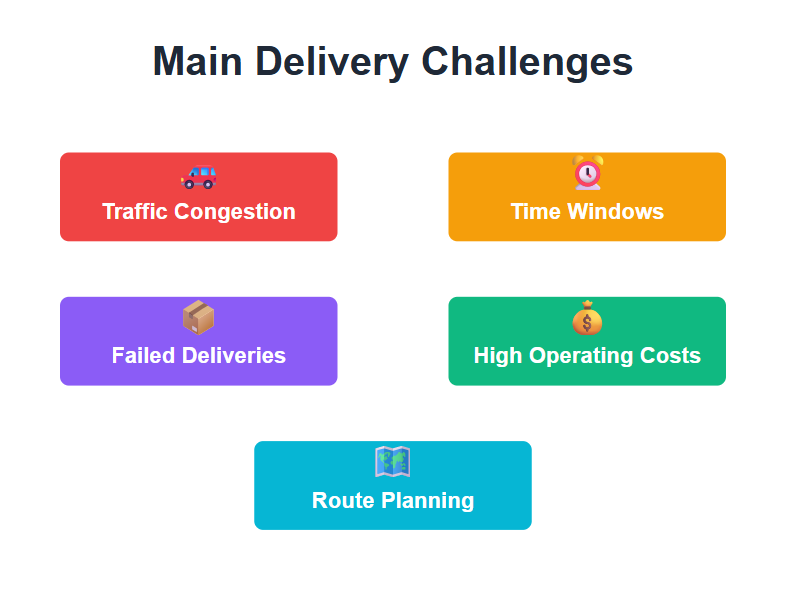
Major Last Mile Delivery Challenges in 2026
Rising Operational Costs and Margin Pressure
Let’s talk money. One of the biggest challenges hitting delivery businesses in 2026 is that costs keep going up fuel prices swing wildly, vehicle maintenance gets more expensive, and finding good drivers costs more than ever.
But here’s the catch: customers aren’t willing to pay much more for delivery. In most markets, fast delivery is already expected for free or close to it. You’re stuck in this squeeze where every delivery costs more to fulfill, but you can’t really charge more for it.
And if you’re still planning routes manually or dispatching inefficiently? You’re burning money on wasted fuel, extra time, and underutilized driver capacity. Trying to scale without automation often just means your costs go up faster than your revenue.
Manual Dispatching: One of the biggest Last Mile delivery challenges
Believe it or not, plenty of delivery teams are still doing manual dispatching in 2026. If you’re assigning tasks through spreadsheets, email chains, or group chats, you know how chaotic it gets.
Manual dispatching leads to drivers getting unbalanced workloads – one person’s overwhelmed while another finishes early. Routes aren’t optimized, so drivers take longer than necessary. And when order volumes spike? Even small mistakes can derail your entire day.
What works at 50 deliveries completely falls apart at 500 or 5,000. That’s why so many businesses are finally moving to automated dispatch systems like the ones in Tookan.
Failed Deliveries and Low First Attempt Success Rates
Failed delivery attempts are expensive and frustrating for everyone involved. In 2026, customers expect you to get it right the first time – they want accurate delivery windows and updates that actually help them plan their day.
Every failed delivery means burning more fuel, paying drivers for extra time, and dealing with unhappy customers. Your support team gets flooded with “where’s my order?” messages, and you have to send someone back out again.
Cutting down on failed deliveries requires better route planning, real-time updates, and proactive communication – things that are really hard to pull off manually.
Lack of Real-Time Visibility and Operational Control
Another major pain point in 2026 is not having real-time visibility into what’s actually happening out there. Without live tracking, you’re basically flying blind. You can’t spot bottlenecks until they’ve already caused delays, and you’re always reacting instead of getting ahead of problems.
From your customer’s perspective, this lack of transparency is even worse. They just want to know where their order is and when it’ll show up. If you can’t tell them that, you’re eroding trust with every delivery.
Delivery management platforms like Tookan solve this by giving you centralized dashboards and real-time tracking that both your team and your customers can see.
Poor Customer Communication During the Delivery Journey
Customer communication can make or break the delivery experience. In 2026, people expect regular updates, realistic ETAs, and clear notifications from start to finish.
When you’re handling communication manually or inconsistently, things slip through the cracks. Customers miss deliveries because they weren’t properly notified. Your support team spends all day answering “where is it?” questions. Automated notifications – which are now standard in modern platforms – help smooth this out and improve your success rates.
Difficulty Scaling Delivery Operations
Scaling is where a lot of businesses hit a wall. Manual processes might work fine when you’re small, but they completely break down as you grow.
The instinct is often to just hire more dispatchers or drivers, but that increases costs and complexity without really solving the underlying problems. Without automation, trying to scale usually just means you’re dealing with bigger messes instead of bigger success.
This is exactly why scalable delivery platforms like Tookan are becoming essential for businesses with growth plans.
Lack of Data and Actionable Insights
In 2026, if you’re not making decisions based on data, you’re guessing. The problem is, many businesses don’t have access to centralized, meaningful insights about their delivery performance.
Without good analytics, you can’t really tell which routes are efficient, how drivers are performing, what your actual cost per delivery is, or where you’re losing time and money. You end up trying to optimize based on hunches instead of facts.
Modern automation platforms fix this by pulling all your delivery data together and turning it into insights you can actually use.
Why Traditional Delivery Models Are No Longer Effective
Traditional delivery models lean heavily on manual coordination and a patchwork of different tools. While that might have worked back in the day, it just can’t handle the scale and complexity of last-mile delivery in 2026.
Simply adding more people or vehicles doesn’t fix the core inefficiencies. What you really need are systems that can adapt on the fly, continuously optimize operations, and scale without piling on more overhead.
How Automation Solves Last Mile Delivery Challenges in 2026
Automated Order Allocation and Smart Dispatching
Automation takes the guesswork out of task assignment. Instead of someone manually deciding who delivers what, orders get allocated automatically based on location, driver availability, capacity, and whatever rules you’ve set up. It’s faster and more accurate.
Platforms like Tookan let your team step back from the manual grind while still keeping full control over how things run.
Route Optimization for Speed, Cost, and Sustainability
Automated route optimization calculates the most efficient routes in real time, factoring in traffic, delivery windows, and distance. By cutting down on unnecessary travel and avoiding congestion, you save on fuel costs and get deliveries done faster.
This is now a core feature in modern delivery management systems, and it’s also key for running more sustainable operations.
Real-Time Tracking and End to End Visibility
Real-time tracking gives you complete visibility into your operations. You can monitor progress as it happens, catch issues early, and fix problems before they snowball.
Your customers benefit too – they get live tracking that shows exactly where their delivery is, which builds trust and reduces anxiety.
Automated Customer Communication
Automation platforms handle customer notifications for you, sending timely updates at every stage of the delivery. This cuts down on missed deliveries, keeps customers happy, and reduces the load on your support team.
Driver Apps That Improve Productivity
Modern driver apps guide your drivers through optimized routes, let them capture proof of delivery, and enable real-time updates back to your system. These tools make drivers more efficient and help reduce errors, especially when you’re operating at scale.
Centralized Systems for Scalable Growth
Instead of juggling multiple disconnected tools, you get everything in one place. Delivery management platforms like Tookan give you centralized control, which makes scaling smoother and helps you maintain consistent service quality as you grow.
Analytics and Continuous Improvement
Advanced analytics help you track performance metrics, spot inefficiencies, and keep optimizing over time. In 2026, these data-driven insights aren’t optional -they’re essential for staying competitive.
Why Automation Is a Competitive Advantage in 2026
Here’s the bottom line: in 2026, delivery automation isn’t a nice to have anymore. Businesses that embrace automation can operate more efficiently, scale faster, and deliver better customer experiences.
The ones that don’t? They risk falling behind competitors who are leveraging platforms like Tookan to optimize their last-mile operations.
Preparing Your Last Mile Strategy for the Future
As we move through 2026, it’s worth taking a hard look at how mature your last-mile operations really are. Automation-first strategies give you better cost control, more reliability, and the ability to keep up with evolving customer expectations.
Conclusion: The Future of Last Mile Delivery Is Automated
Last-mile delivery in 2026 comes with some serious challenges – from rising costs to sky-high customer expectations. But here’s the good news: these challenges are totally solvable with the right technology and strategy.
Automation platforms used by modern delivery teams worldwide give you the tools to streamline operations, improve visibility, and scale sustainably. Solutions like Tookan help businesses shift from reactive firefighting to proactive, data-driven operations.
As we kick off the new year, one thing is crystal clear:
The future of last-mile delivery belongs to businesses that embrace automation.
Many businesses are now turning to delivery management software to overcome last mile delivery challenges at scale.
Link to: https://www.superhippo.ai/tookan/
Subscribe to stay ahead with the latest updates and entrepreneurial insights!
Share this article:


Subscribe to our newsletter
Get access to the latest industry & product insights.
You may be interested in these articles
-
Jungleworks8th January 2026
How Real-Time Tracking Improves Customer Experience in On-Demand DeliveryLet's be honest. We've all been there, refreshing that order page obsessively,.. [..]Read story
-
Jungleworks6th January 2026
7 Signs Your Field Force Operations Are Costing You More Than You ThinkLet me tell you something that most field service managers will not openly.. [..]Read story
-
Jungleworks29th December 2025
Scaling Last-Mile Operations: Growing from 100 to 10,000 Deliveries DailyScaling last-mile delivery is never a straight line. You might start with just.. [..]Read story
-
Jungleworks22nd December 2025
How Delivery Management Software Helps Businesses GrowIn today's hyper-connected digital economy, the expectations placed on.. [..]Read story