

Blog hippo
hippo
How WhatsApp Authentication Is Changing User Login
WhatsApp authentication is changing how businesses can approach the user login experience. Instead of asking users to wait for an SMS, find an OTP, copy the code, and enter it manually, businesses can use WhatsApp to create a simpler authentication journey.
However, traditional SMS OTPs are familiar, but they can still introduce friction. Delayed messages, failed deliveries, repeated OTP requests, and manual code entry can make a simple login process feel unnecessarily complicated.
As a result, businesses are exploring alternatives that can make authentication more convenient without adding more steps for the user.
One such approach is WhatsApp authentication through magic links. With NOTP by Hippo, users can select Login with WhatsApp, receive a magic link through WhatsApp, tap the link, and return to the application authenticated.
The journey becomes simple:
Login with WhatsApp → Receive magic link → Tap the link → Logged in
What Is WhatsApp Authentication?
WhatsApp-based authentication is a login or verification method that uses WhatsApp as part of the authentication journey.
Instead, businesses can use WhatsApp to send an authentication message to the user’s phone rather than depending entirely on SMS to deliver a one-time password.
Moreover, NOTP takes this approach a step further by using a magic-link authentication flow.
The user doesn’t need to manually copy and enter an OTP. Instead, they can receive a link through WhatsApp, tap it, and return to the application authenticated.
The result is a simpler journey:
Login with WhatsApp → Receive magic link → Tap the link → Logged in
How Does WhatsApp Authentication Work With NOTP?
The NOTP authentication flow is designed to keep the login experience simple.
1. Click “Login with WhatsApp”
First, users choose the Login with WhatsApp option on the website or application.
2. WhatsApp Opens
Next, WhatsApp opens and an authentication message is delivered.
3. Receive the Magic Link
Once the message arrives, users can access the authentication link and continue the login process.
4. Tap the Link
Instead of entering an OTP manually, the user simply taps the magic link.
5. Return to the Application
Finally, the link redirects the user to the application and completes the authentication process.
In short:
No waiting for an SMS. No copying codes. Just tap the link and log in.
As a result, users can complete authentication through a familiar messaging channel with fewer manual steps.
Why Are Businesses Moving Beyond SMS OTP?
SMS OTPs have been widely used for authentication. However, they can sometimes add unnecessary steps to the login process.
Meanwhile, as digital experiences become more streamlined, businesses are looking for authentication methods that reduce friction while keeping the user journey simple.
For example, a traditional OTP flow may require users to wait for a message, find the verification code, return to the application, and enter it manually. In contrast, a magic-link experience can reduce these interactions.
With that in mind, here are some reasons why WhatsApp authentication is worth considering.
1. Reduce Manual OTP Entry
Traditional OTP authentication requires users to receive a code and enter it manually. With a magic-link flow, however, users can authenticate by simply tapping a link.
As a result, fewer manual steps can create a smoother login experience.
2. Use a Familiar Communication Channel
Many customers already use WhatsApp to communicate with businesses, friends, and family. Therefore, using a familiar channel for authentication can make the login process feel more natural.
Instead of introducing another unfamiliar step, businesses can incorporate authentication into a communication channel that users already understand.
3. Simplify the Login Journey
Every additional step in a user journey can create another opportunity for friction.
In contrast, the traditional process requires several manual interactions.
SMS → Find OTP → Copy OTP → Return to app → Enter OTP → Submit
By comparison, a magic-link flow can be much simpler:
WhatsApp → Tap link → Login
4. Offer an Alternative to SMS Authentication
Businesses don’t necessarily have to rely on a single authentication channel. Depending on their requirements, WhatsApp-based authentication can provide another option alongside existing authentication methods.
This flexibility can be useful for businesses that want to explore different ways of improving their login experience.
5. Improve the Overall Customer Experience
Authentication is often one of the first interactions a customer has with a digital product. For this reason, creating a simple and intuitive login process can contribute to a better overall experience.
WhatsApp Authentication vs SMS OTP
Both approaches can be used to authenticate users, but the user experience can be different.
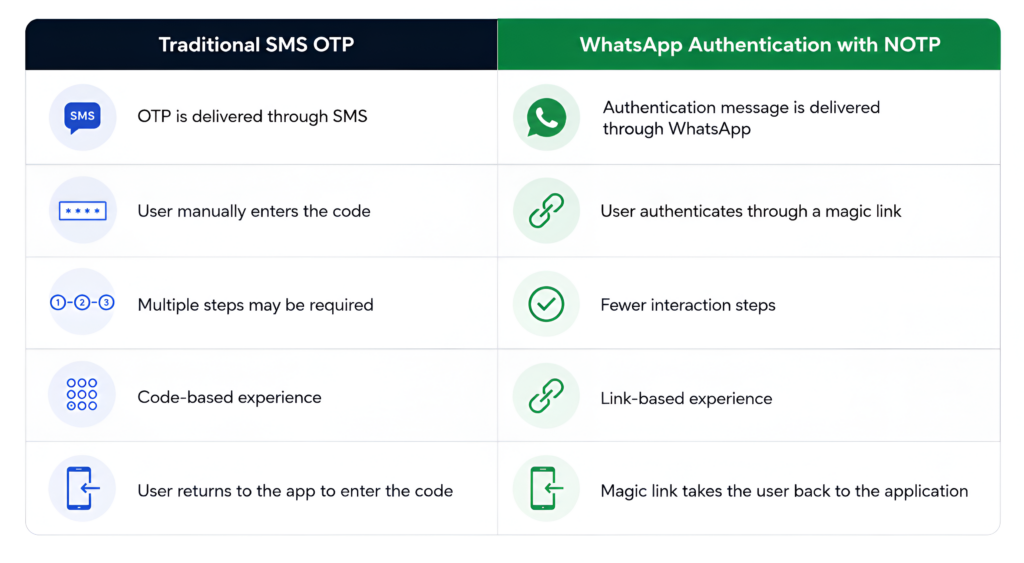
The key difference is not simply SMS vs WhatsApp.
It is the authentication experience itself.
NOTP focuses on replacing manual OTP entry with a magic-link-based flow.
Is WhatsApp Authentication Secure?
Security is an important consideration for any authentication system.
Using WhatsApp as an authentication channel does not automatically make a system secure or insecure. The overall security depends on how the authentication system is designed and implemented.
Businesses implementing magic-link authentication should consider security practices such as:
- Secure token generation and handling
- HTTPS for authentication requests
- Expiration of authentication links
- One-time-use authentication links
- Proper session management
- Rate limiting
- Monitoring suspicious authentication activity
- Appropriate account recovery processes
These controls help ensure that convenience does not come at the expense of security.
Businesses should also evaluate their authentication requirements, user journeys, and compliance obligations before selecting an authentication method.
WhatsApp Authentication vs WhatsApp OTP
These two concepts are often confused.
WhatsApp OTP simply means an OTP is delivered to the user through WhatsApp.
The user still receives a code and enters it manually.
NOTP uses a different approach.
Instead of asking users to copy and enter a code, the authentication journey uses a magic link.
So the experience becomes:
WhatsApp OTP:
Receive code → Copy → Enter → Verify
NOTP:
Receive magic link → Tap → Authenticate
This distinction is important because NOTP is designed around reducing manual OTP entry rather than simply moving an OTP from SMS to WhatsApp.
Where Can WhatsApp Authentication Be Used?
WhatsApp authentication can be considered for a variety of customer-facing digital experiences.
E-commerce
For example, online stores can use simpler authentication when customers access their accounts, orders, or other account-related features.
SaaS Platforms
Similarly, SaaS products can offer WhatsApp-based login as an alternative authentication experience for their users.
Healthcare
In healthcare, applications and platforms can explore simpler authentication journeys for patients and customers, subject to their security and compliance requirements.
Education
Meanwhile, educational platforms can consider alternative authentication methods for students, parents, and other users.
Marketplaces
For marketplaces, WhatsApp authentication can provide another option for customers, sellers, and other platform users.
Web and Mobile Applications
More broadly, applications that require phone-based authentication can evaluate whether WhatsApp authentication fits their user journey.
WhatsApp Authentication and Passwordless Login
WhatsApp-based magic-link authentication is also connected to the broader move toward passwordless experiences.
Traditional authentication often asks users to remember passwords or manually enter verification codes.
Passwordless approaches aim to reduce this burden by allowing users to authenticate through other mechanisms.
With a magic-link approach, the experience can look like:
Traditional:
Password → OTP → Login
Magic link:
WhatsApp → Magic Link → Login
The goal isn’t simply to remove one authentication method and replace it with another.
It’s to create an authentication journey that is easier for the user while maintaining appropriate security controls.
What Is NOTP by Hippo?
NOTP by Hippo is a WhatsApp-based authentication solution designed to simplify the user login experience.
Rather than requiring users to manually enter a traditional SMS OTP, NOTP uses a WhatsApp-based magic-link flow.
The process is straightforward:
Click “Login with WhatsApp” → Receive a WhatsApp message → Tap the magic link → Return to the application
For businesses, this provides an alternative approach to traditional OTP-based authentication. At the same time, users get a login journey with fewer manual steps.
Ultimately, the goal is simple: make authentication easier without making the user work harder.
Who Can Benefit From WhatsApp Authentication?
WhatsApp-based authentication can be particularly relevant for businesses that:
- Want to reduce friction during login
- Currently rely on SMS OTP workflows
- Experience authentication-related drop-offs
- Already communicate with customers through WhatsApp
- Want to explore passwordless authentication
- Want to reduce manual verification steps
- Need a convenient authentication option for web or mobile users
The right authentication method ultimately depends on the business, its users, technical architecture, and security requirements.
The Future of WhatsApp Authentication
Authentication has an important job: verifying that the right user is accessing the right account.
But authentication doesn’t have to feel complicated.
As customers become accustomed to fast, seamless digital experiences, businesses have an opportunity to rethink traditional login journeys.
WhatsApp-based authentication is one example of this shift.
Instead of asking users to wait for an SMS, find a code, copy it, switch back to an application, and enter it manually, businesses can explore authentication flows built around familiar channels and fewer interactions.
With NOTP, that experience can be as simple as:
Login with WhatsApp → Tap the magic link → You’re in.
Conclusion
SMS OTP authentication has played an important role in digital identity verification, but the way users authenticate is evolving.
Businesses are increasingly looking for ways to make login faster, simpler, and less frustrating without compromising the security of the authentication process.
WhatsApp-based authentication offers another path forward.
By using WhatsApp to deliver a magic link, NOTP allows businesses to move away from manual OTP entry and create a more streamlined authentication journey.
For users, that means fewer steps.
For businesses, it means another way to rethink the login experience.
Authentication shouldn’t be a hurdle. It should simply get users where they need to go.
Ready to explore a simpler authentication experience?
Discover how NOTP by Hippo can help you bring WhatsApp-based magic-link authentication to your customer login journey.
Subscribe to stay ahead with the latest updates and entrepreneurial insights!
Share this article:


Subscribe to our newsletter
Get access to the latest industry & product insights.
You may be interested in these articles
-
hippo31st August 2026
AI Customer Engagement: Fixing Voice Bot Flaws.Think about the last time you called a business and heard, “Press 1 for.. [..]Read story
-
hippo21st August 2026
Missed Calls Are Costing You Customers: Here’s WhyMissed calls can cost businesses more than a conversation. They can mean lost.. [..]Read story
-
hippo12th August 2026
How AI Inbound Calling Helps Businesses Never Miss a Customer CallA missed customer call can mean a missed lead, a lost sale, or a customer.. [..]Read story
-
hippo10th August 2026
AI Voice Agent for Real Estate: Capture More Property Leads 24/7An AI Voice Agent for Real Estate ensures that every inquiry is answered.. [..]Read story