

Blog hippo
hippo
Apple Passkeys: Are They More Secure Than Passwords?
Apple Passkeys are changing the way people log into apps and websites. Instead of relying on passwords that can be forgotten, stolen, or reused, Apple introduced a passwordless authentication system designed to make logins both simpler and more secure.
But why did Apple make this change? More importantly, what can businesses learn from Apple’s move toward passwordless authentication?
Apple Passkeys represent one of the biggest shifts in online authentication, and businesses should understand why they’re becoming the new standard.
Why Apple Passkeys Matter More Than Passwords
Passwords have become one of the weakest links in online security.
Most users:
- Reuse the same password across multiple websites.
- Choose passwords that are easy to guess.
- Forget their passwords frequently.
- Fall victim to phishing attacks.
According to industry reports, stolen or compromised credentials remain one of the leading causes of data breaches worldwide.
Even adding SMS OTPs (One-Time Passwords) isn’t a perfect solution. SMS-based authentication can be vulnerable to SIM swapping, phishing, and delivery delays.
Businesses also face higher support costs due to password resets and account recovery requests.
What Are Apple Passkeys?
Passkeys are a passwordless authentication method developed by the FIDO Alliance in collaboration with companies including Apple, Google, and Microsoft.
Unlike traditional passwords, Apple Passkeys use public-key cryptography and biometric authentication to verify users securely without requiring them to remember complex credentials.
Instead of asking users to remember a password, Passkeys use cryptographic key pairs stored securely on a trusted device.
Authentication happens through:
- Face ID
- Touch ID
- Fingerprint
- Device PIN
- Biometrics
This means users never have to create or remember a password.
Why Apple Passkeys Replace Traditional Passwords
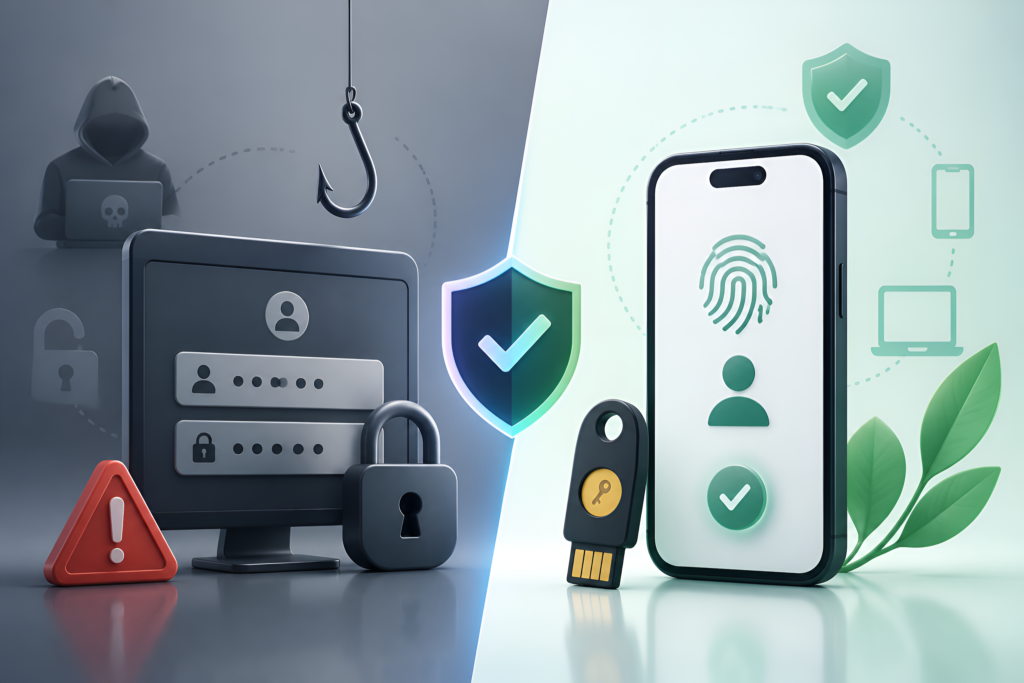
Apple’s decision was driven by three major reasons. This is one of the biggest reasons Apple Passkeys are being adopted across the technology industry.
1. Better Security
Passwords can be stolen.
Passkeys cannot simply be guessed or reused.
Because authentication relies on cryptographic keys tied to your device, attackers cannot easily steal them through phishing websites.
2. Faster Login Experience
Nobody enjoys typing long passwords.
With Passkeys, users simply authenticate using Face ID or Touch ID.
The login process becomes almost instant.
3. Reduced Phishing Attacks
Phishing works because users manually enter passwords.
Passkeys never expose the actual authentication key to websites.
Even if someone creates a fake login page, the Passkey won’t authenticate unless it’s the legitimate site.
This dramatically reduces phishing risks.
Apple Passkeys vs Passwords
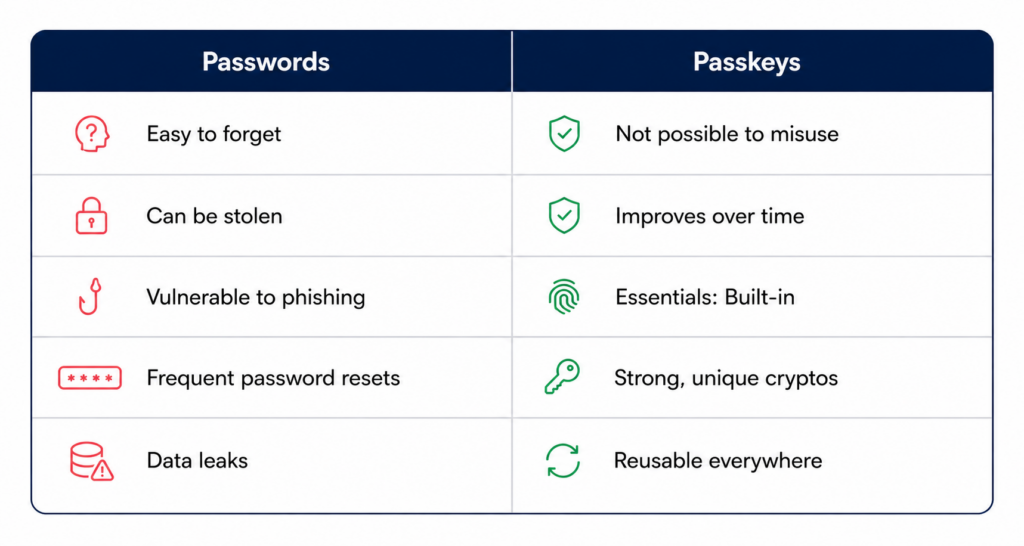
For both consumers and businesses, Apple Passkeys provide a better balance of security, convenience, and privacy than traditional passwords.
Why Apple Passkeys Represent the Future of Authentication
Apple’s move signals a broader industry trend.
Customers increasingly expect:
- Secure login experiences
- Faster authentication
- Fewer passwords
- Better privacy
- Seamless access across devices
Businesses that continue relying only on passwords—or even SMS OTPs—may eventually struggle to meet those expectations.
Modern authentication methods help reduce fraud, improve customer trust, and streamline the user experience.
Is SMS OTP Enough Anymore?
Businesses looking for a more secure alternative can explore NOTP, SuperHippo’s passwordless authentication solution.
SMS OTPs represented a significant improvement over passwords, but they also have limitations.
Challenges include:
- SIM swap attacks
- Delayed message delivery
- SMS interception
- User frustration during login
- Additional messaging costs
As cyber threats continue to evolve, many organizations are exploring passwordless authentication methods that reduce reliance on SMS altogether.
The Future Is Passwordless
Apple’s adoption of Passkeys isn’t an isolated decision.
Many leading technology companies are embracing passwordless authentication because it offers:
- Better security
- Improved customer experience
- Lower support costs
- Faster authentication
- Stronger protection against phishing
For businesses, the takeaway is clear: authentication is evolving, and customer expectations are evolving with it.
Beyond Passkeys: The Next Generation of Authentication
While Passkeys are a major leap forward, businesses often need authentication methods that fit a variety of customer journeys—whether it’s onboarding, verifying transactions, or accessing services across multiple channels.
This is where newer approaches to passwordless authentication are emerging. Platforms like SuperHippo are exploring alternatives that reduce dependence on traditional passwords and SMS OTPs while helping businesses deliver secure, frictionless customer experiences across web, mobile, and messaging channels.
The goal isn’t just stronger security—it’s making authentication simpler, faster, and more user-friendly.
Final Thoughts
Apple didn’t replace passwords simply because they were old.
It replaced them because today’s digital world demands authentication that is both more secure and more convenient.
Passkeys demonstrate that security doesn’t have to come at the cost of usability. As more organizations adopt passwordless technologies, businesses that modernize their authentication strategies will be better positioned to protect users and build lasting trust.
Whether you’re a startup or an enterprise, now is the right time to evaluate how your customers log in—and whether your authentication experience is ready for the future.
Subscribe to stay ahead with the latest updates and entrepreneurial insights!
Share this article:


Subscribe to our newsletter
Get access to the latest industry & product insights.
You may be interested in these articles
-
hippo31st August 2026
AI Customer Engagement: Fixing Voice Bot Flaws.Think about the last time you called a business and heard, “Press 1 for.. [..]Read story
-
hippo21st August 2026
Missed Calls Are Costing You Customers: Here’s WhyMissed calls can cost businesses more than a conversation. They can mean lost.. [..]Read story
-
hippo13th August 2026
How WhatsApp Authentication Is Changing User LoginWhatsApp authentication is changing how businesses can approach the user login.. [..]Read story
-
hippo12th August 2026
How AI Inbound Calling Helps Businesses Never Miss a Customer CallA missed customer call can mean a missed lead, a lost sale, or a customer.. [..]Read story