

Blog hippo
hippo
Conversational AI: The Future of Customer Engagement
Customers Don’t Want More Marketing. They Want Better Conversations.
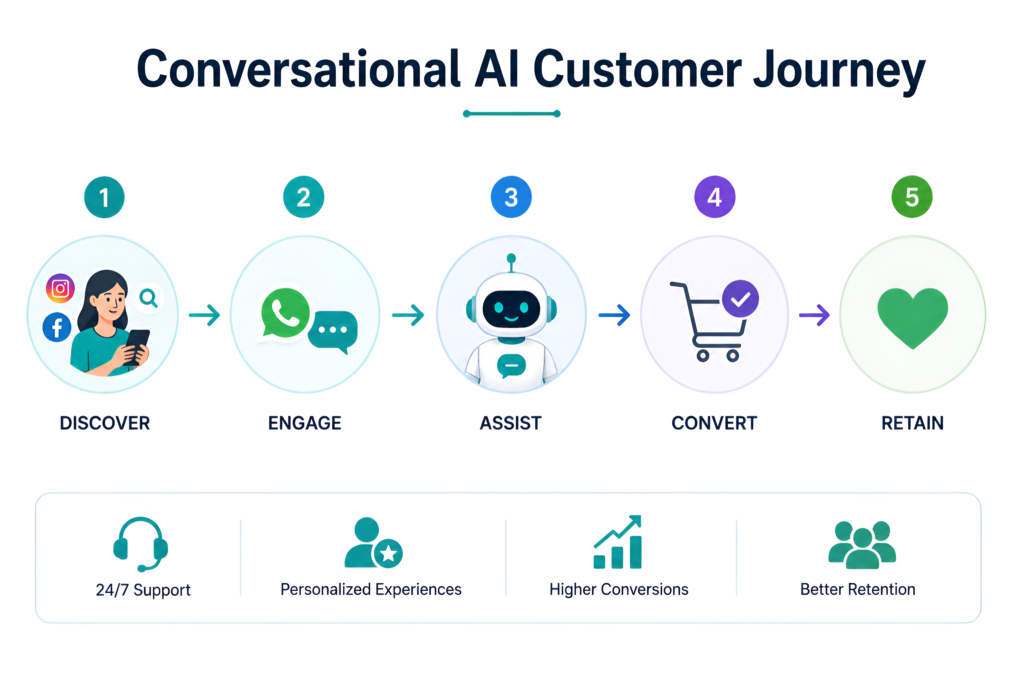
Conversational AI is transforming customer engagement faster than any technology in recent years. For decades, businesses relied on emails, advertisements, and traditional marketing campaigns to communicate with customers. Today, customers expect instant, personalized conversations across every channel, making conversational AI a critical part of modern customer engagement strategies.
That world no longer exists.
Today’s customers live in an environment where information is available instantly, alternatives are only a click away, and expectations are higher than ever. They can compare products, read reviews, watch demonstrations, and switch providers within minutes. As a result, traditional marketing tactics alone are no longer enough to capture attention or build loyalty.
Modern customers don’t just want information—they want interaction. They expect businesses to be available when they have questions, respond quickly when they need support, and provide personalized experiences that feel relevant to their needs. Whether they are browsing a website, sending a WhatsApp message, making a phone call, or interacting through live chat, customers increasingly prefer conversational experiences over one-way communication.
This shift is transforming customer engagement from a marketing function into an ongoing relationship-building strategy. Businesses that embrace conversation as the foundation of customer engagement are seeing stronger customer relationships, higher conversion rates, improved retention, and better overall customer experiences.
The future of customer engagement is no longer about reaching customers. It’s about having meaningful conversations with them.
Why Conversational AI Is Replacing Traditional Customer Engagement
Traditional engagement strategies were built around broadcasting messages to large audiences. Businesses relied heavily on email marketing, paid advertisements, SMS campaigns, and social media promotions to generate awareness and drive action.
While these channels remain important, their effectiveness has declined as customer behavior has evolved.
Consumers are exposed to thousands of marketing messages every day. Their inboxes are crowded. Social feeds are saturated with promotional content. Advertisements compete aggressively for limited attention spans. As a result, customers have become increasingly selective about what they engage with.
The challenge isn’t necessarily that businesses are communicating less. In many cases, they are communicating more than ever before. The problem is that most communication still feels one-sided.
Customers don’t want to be talked at. They want to be heard.
The businesses that continue treating engagement as a series of campaigns often struggle to meet these expectations. Meanwhile, organizations that prioritize conversations create stronger connections and deliver better customer experiences.
The Shift From Campaigns to Conversations
The most successful businesses today understand that customer engagement is no longer defined by how many messages are sent. It’s defined by the quality of interactions that occur.
Instead of focusing solely on campaigns, companies are building systems designed to facilitate ongoing conversations throughout the customer journey.
Consider a typical modern buying experience.
A potential customer discovers a brand through social media. They visit the website and ask a question through live chat. Later, they receive a follow-up message on WhatsApp. After making a purchase, they receive onboarding guidance and support through multiple channels. Weeks later, the business reaches out with personalized recommendations based on previous interactions.
At every stage, the customer feels supported because the relationship is built around conversation rather than promotion.
This approach creates a significantly better experience. Customers receive answers faster, feel more understood, and develop greater trust in the brand.
The result is not only higher engagement but also stronger long-term customer relationships.
Why Speed Has Become a Competitive Advantage
According to Salesforce‘s State of the Connected Customer report, customers increasingly expect companies to respond faster than ever before.
Conversational AI helps businesses maintain fast response times without increasing the size of their customer support or sales teams.
One of the biggest drivers behind conversational engagement is the increasing demand for speed.
Customers today expect immediate responses. Waiting hours—or even minutes in some situations—can be enough to lose a prospect or frustrate an existing customer.
Imagine a potential buyer comparing solutions from three different companies. If one business responds instantly while another takes several hours, which company is more likely to earn the customer’s trust?
Speed communicates professionalism, reliability, and customer focus.
However, maintaining rapid response times becomes increasingly difficult as businesses grow. More customers mean more inquiries, more support requests, more leads to follow up with, and more conversations to manage.
Without the right systems in place, teams quickly become overwhelmed.
Sales representatives miss follow-ups.
Support agents experience backlogs.
Leads lose interest.
Customers become frustrated.
Businesses that can respond quickly and consistently gain a significant competitive advantage. This is why conversational technologies and automation tools are becoming essential components of modern engagement strategies.
How Conversational AI Powers Omnichannel Communication

Today’s customers don’t interact through a single channel. They move seamlessly between platforms depending on convenience, urgency, and personal preference.
Many businesses are now using WhatsApp marketing to engage customers where they already spend most of their time.
Another may choose email.
Some prefer voice calls.
Others may rely on live chat or social messaging platforms.
The challenge for businesses is ensuring that communication remains consistent regardless of where the interaction begins.
This is where omnichannel engagement becomes critical.
Omnichannel communication allows businesses to maintain a unified customer experience across multiple touchpoints. Instead of treating each channel separately, businesses create connected conversations that follow customers throughout their journey.
For example, a customer might:
- Discover a business through social media.
- Ask questions through WhatsApp.
- Receive a follow-up call.
- Contact support through live chat.
- Complete a purchase through an automated workflow.
From the customer’s perspective, these interactions should feel like one continuous conversation.
Businesses that successfully implement omnichannel communication are able to create smoother experiences, reduce customer friction, and improve satisfaction across every stage of engagement.
How Conversational AI Enables Scalable Customer Communication
According to McKinsey, organizations are increasingly investing in AI-driven customer engagement solutions to improve efficiency and customer satisfaction.
The biggest challenge with conversation-based engagement is scale.
A startup may handle dozens of customer conversations each day. A growing company may handle thousands. Enterprises often manage millions of customer interactions annually.
Historically, scaling customer communication required hiring more support agents, expanding sales teams, and increasing operational costs.
Artificial Intelligence is changing that equation.
Modern AI-powered engagement platforms can automate a wide range of customer interactions while maintaining speed, consistency, and personalization. Solutions like AI voice agents, automated messaging, and customer support automation help businesses engage customers without increasing operational overhead.
AI can help businesses:
- Answer frequently asked questions.
- Qualify leads automatically.
- Schedule appointments.
- Follow up with prospects.
- Provide customer support.
- Collect feedback.
- Conduct surveys.
- Recover abandoned carts.
- Launch retention campaigns.
This doesn’t mean replacing human employees.
Instead, AI handles repetitive and time-consuming tasks while human teams focus on more complex and strategic interactions.
The result is a more efficient operation that can maintain high-quality customer engagement without dramatically increasing costs.
Why Voice Is Emerging as a Powerful Engagement Channel
While digital messaging continues to grow, voice remains one of the most trusted forms of communication.
Hearing a voice creates a level of connection that text often cannot replicate. Conversations over phone calls feel personal, direct, and human.
For years, however, voice communication presented a scalability challenge. Businesses needed large teams to manage inbound and outbound calls effectively.
Today, AI Voice Agents are making voice engagement more accessible than ever.
These systems can handle a variety of tasks, including:
- Lead qualification calls
- Appointment confirmations
- Customer support interactions
- Order verification
- Feedback collection
- Follow-up campaigns
Because AI Voice Agents can operate continuously, businesses gain the ability to provide support and engagement beyond traditional working hours.
This allows organizations to improve responsiveness while reducing operational burden.
Voice is rapidly becoming a critical component of conversational engagement strategies, especially for businesses seeking to provide personalized customer experiences at scale.
Customer Retention Begins With Meaningful Conversations
Many organizations invest heavily in customer acquisition while overlooking retention.
Yet acquiring a new customer is often significantly more expensive than retaining an existing one.
The most effective retention strategies are built around communication.
Customers remain loyal when they feel valued, supported, and understood. Consistent engagement helps businesses strengthen relationships and identify opportunities to improve customer experiences before problems arise.
Businesses often combine retention campaigns, loyalty programs, and personalized engagement workflows to keep customers active and satisfied.
Retention-focused conversations may include:
- Personalized recommendations
- Loyalty rewards
- Proactive support outreach
- Feedback requests
- Re-engagement campaigns
- Product education
These interactions demonstrate that the business cares about customer success beyond the initial transaction.
When customers feel connected to a brand, they are more likely to continue purchasing, recommend the business to others, and remain loyal over time.
Recovering Lost Revenue Through Automated Conversations
Every business loses potential revenue through abandoned customer actions.
Customers leave items in shopping carts.
Prospects stop responding to follow-ups.
Forms remain incomplete.
Appointments go unscheduled.
Traditionally, many businesses accepted these losses as unavoidable.
Today, conversational engagement provides a powerful opportunity to recover lost revenue.
Automated reminders delivered through WhatsApp, email, SMS, or voice calls can re-engage customers at critical moments.
abandoned cart recovery campaigns
A simple message reminding someone about an abandoned cart or incomplete registration can significantly improve conversion rates.
The key is timing and relevance.
Customers are more likely to respond when communication feels helpful rather than intrusive.
Businesses that use automation strategically can recover opportunities that would otherwise disappear.
Building a Conversation-First Business Strategy
Adopting conversational engagement requires more than implementing new technology.
It requires a shift in mindset.
Businesses should focus on four key principles:
Be Accessible
Allow customers to connect through the channels they already use and trust.
Be Responsive
Reduce response times and make support available when customers need it.
Be Personalized
Use customer data and context to create more relevant interactions.
Be Consistent
Ensure conversations remain connected across channels and touchpoints.
When these principles are combined with modern automation and AI capabilities, businesses can create customer experiences that feel seamless, engaging, and human.
The Future of Conversational AI in Customer Engagement
Research from Gartner predicts that conversational technologies will continue to play a larger role in customer service and customer experience strategies.
Customer engagement is moving beyond campaigns and entering an era defined by conversations.
Customers increasingly expect businesses to communicate in real time, provide personalized experiences, and remain available across multiple channels.
As technology continues to evolve, the gap between customer expectations and traditional communication methods will continue to widen.
Businesses that embrace conversational engagement will be better positioned to build trust, improve customer satisfaction, increase retention, and drive long-term growth.
Those that continue relying solely on one-way communication may struggle to remain competitive in a market where relationships matter more than ever.
The future belongs to organizations that understand a simple truth:
People don’t want more marketing.
They want better conversations.
Conclusion
Customer engagement is no longer about sending more emails, launching more campaigns, or increasing advertising budgets. Success now depends on how effectively businesses communicate with customers throughout their journey.
Whether through voice, chat, WhatsApp, email, or other channels, conversations have become the foundation of modern customer relationships.
Organizations that prioritize meaningful, timely, and personalized interactions will create stronger customer loyalty, higher conversion rates, and sustainable business growth.
The question is no longer whether conversational engagement is the future.
The question is whether your business is ready for it.
Subscribe to stay ahead with the latest updates and entrepreneurial insights!
Share this article:


Subscribe to our newsletter
Get access to the latest industry & product insights.
You may be interested in these articles
-
hippo1st September 2026
Customer Communication Automation: A Guide for BusinessesCustomer communication automation is changing how businesses interact with.. [..]Read story
-
hippo31st August 2026
AI Customer Engagement: Fixing Voice Bot Flaws.Think about the last time you called a business and heard, “Press 1 for.. [..]Read story
-
hippo21st August 2026
Missed Calls Are Costing You Customers: Here’s WhyMissed calls can cost businesses more than a conversation. They can mean lost.. [..]Read story
-
hippo13th August 2026
How WhatsApp Authentication Is Changing User LoginWhatsApp authentication is changing how businesses can approach the user login.. [..]Read story