

Blog hippo
hippo
Traditional IVR vs AI: Which Customer Support System Wins?
Traditional IVR vs AI has become one of the biggest discussions in customer service. Businesses that once relied on menu-driven IVR systems are now moving toward conversational AI that understands customers naturally, reduces wait times, and delivers faster resolutions. If you’re wondering whether it’s time to replace your traditional IVR, this guide explains the differences, benefits, and why AI-powered conversations are shaping the future of customer support.
Imagine calling customer support after a long day.
Instead of speaking to someone who can help, you’re greeted with:
“Welcome to our customer support.”
“Press 1 for Sales.”
“Press 2 for Technical Support.”
“Press 3 for Billing.”
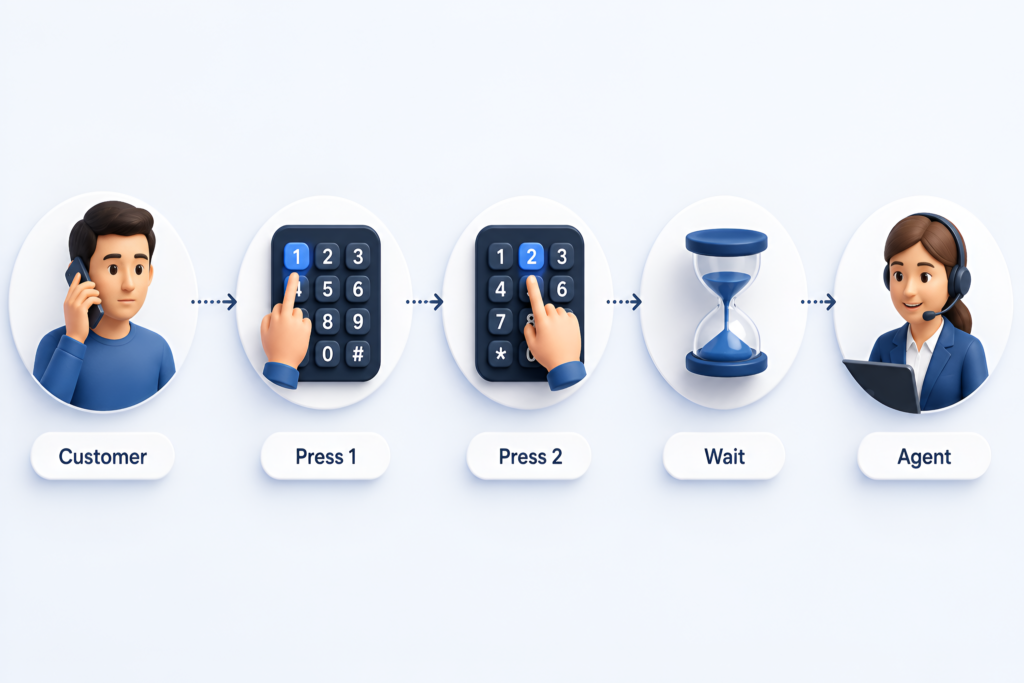
You choose an option, wait on hold, get transferred to another department, repeat your issue, and finally reach the right person.
This experience has become so common that many customers abandon calls before getting the help they need.
For years, Interactive Voice Response (IVR) systems helped businesses manage growing call volumes. But customer expectations have changed dramatically. Today’s customers expect fast, personalized conversations—not endless menu trees.
This is why businesses across healthcare, retail, logistics, banking, education, and SaaS are replacing traditional IVRs with AI Voice Agents.
The shift isn’t about replacing human agents. It’s about replacing outdated technology with conversational AI that understands customers naturally and resolves routine requests more efficiently.
Traditional IVR vs AI Voice Agent: Understanding Traditional IVRs
Interactive Voice Response (IVR) is an automated phone system that guides callers through predefined menus.
A typical IVR follows a fixed sequence:
Customer Calls
      │
      ▼
Press 1 for Sales
Press 2 for Support
Press 3 for Billing
      │
      ▼
Wait in Queue
      │
      ▼
Transferred to Agent
IVRs were designed to reduce the workload on customer service teams by routing calls to the correct department.
While this approach worked well years ago, it struggles to meet the expectations of modern customers who value speed, personalization, and natural conversations.
Traditional IVR vs AI Voice Agent: Problems with Traditional IVRs
1. Customers Hate Menu Navigation
One of the biggest frustrations with IVRs is navigating long lists of options.
Customers often have to listen to every menu before finding the right selection.
If they make a mistake, they must start over.
This creates friction before the conversation even begins.
2. IVRs Don’t Understand Intent
Traditional IVRs rely on button presses or limited voice commands.
They cannot understand natural language like:
“I’d like to change tomorrow’s appointment.”
Instead, customers must translate their request into predefined menu choices.
3. Long Wait Times
Even after selecting the correct option, callers are usually placed in another queue before speaking with an agent.
The result is longer call handling times and lower customer satisfaction.
4. Customers Repeat Themselves
A common complaint is having to explain the same issue multiple times.
Customers first interact with the IVR, then repeat their issue to the support representative.
This creates unnecessary frustration.
5. High Call Abandonment
Every additional step increases the likelihood that customers will hang up.
For businesses, abandoned calls mean:
- Lost sales
- Missed appointments
- Poor customer experience
- Lower retention
Traditional IVR vs AI Voice Agent: Changing Customer Expectations
The Traditional IVR vs AI Voice Agent debate has intensified as customer expectations continue to evolve. Modern consumers expect businesses to understand their needs instantly rather than forcing them through long menu options.
Think about how people communicate today.
People interact with voice assistants every day.
They also send WhatsApp voice messages.
In addition, many now ask AI assistants questions using natural language.
People no longer expect technology to understand button presses.
They expect it to understand them.
This shift is one of the biggest reasons AI Voice Agents are rapidly replacing traditional IVRs.
Traditional IVR vs AI Voice Agent: What Makes AI Different?
An AI Voice Agent is an intelligent conversational system that can answer, understand, and respond to phone calls using natural language.
Instead of asking customers to navigate menus, it simply asks:
“How can I help you today?”
Customers respond naturally:
- “I’d like to book an appointment.”
- “Where is my order?”
- “I’d like to reschedule tomorrow’s delivery.”
- “Can I speak with someone about pricing?”
The AI understands the customer’s intent, retrieves the necessary information, completes the task when possible, or transfers the call with the full context to a human agent.
The interaction feels more like talking to a helpful assistant than navigating a phone system.
Traditional IVR vs AI Voice Agent Across Industries
Healthcare
Instead of navigating appointment menus, patients can simply say:
“I’d like to book a consultation with a dermatologist next week.”
The AI checks availability, schedules the appointment, sends confirmations, and answers common questions.
Real Estate
Potential buyers can call and ask:
“Do you have any three-bedroom apartments under $500,000?”
The AI can qualify the lead, share property details, and schedule a viewing.
E-commerce
Customers ask:
“Where’s my order?”
The AI retrieves order information instantly and provides delivery updates without requiring human intervention.
Banking
Customers can inquire about account information, card services, or loan applications through natural conversation while maintaining secure verification processes.
Logistics
Businesses handling thousands of deliveries each day can automate shipment tracking, delivery scheduling, and customer notifications.
Traditional IVR vs AI Voice Agent: Why Businesses Are Making the Switch
Faster Customer Service
Customers receive immediate assistance instead of navigating menus and waiting on hold. https://www.mckinsey.com/capabilities/quantumblack/our-insights/the-state-of-ai
Reduced Operational Costs
Routine inquiries—such as appointment scheduling, order tracking, FAQs, and lead qualification—can be automated, reducing pressure on support teams.
24/7 Availability
Unlike human teams, AI Voice Agents operate around the clock, ensuring customers receive assistance whenever they call.
Higher Customer Satisfaction
Natural conversations create smoother experiences, leading to happier customers and stronger brand loyalty.
Better Lead Qualification
AI can ask qualifying questions, collect relevant details, and automatically route high-quality leads to the sales team.
Traditional IVR vs AI Voice Agent: Do Human Agents Still Matter?
No.
This is one of the biggest misconceptions surrounding AI Voice Agents.
The goal is not to replace people.
Instead, AI eliminates repetitive work so human agents can focus on more complex conversations.
Human agents remain essential for situations requiring empathy, negotiation, critical thinking, or complex problem-solving.
AI Voice Agents excel at handling repetitive, high-volume tasks such as:
- Appointment booking
- Order tracking
- FAQs
- Lead qualification
- Payment reminders
- Call routing
- Customer verification
When conversations become more complex, the AI can seamlessly transfer the customer to a human representative while preserving the conversation context. This allows agents to focus on high-value interactions instead of routine requests.
Traditional IVR vs AI Voice Agent: The Future of Customer Support
Customer expectations will continue to evolve.
People won’t tolerate complicated phone menus when conversational AI can resolve their requests instantly.
Businesses that continue relying on outdated IVRs risk:
- Losing customers to competitors
- Increasing call abandonment
- Slower response times
- Lower customer satisfaction
Organizations adopting AI Voice Agents are building support experiences that are faster, smarter, and more customer-centric.
How to Choose the Right AI Voice Agent After Comparing Traditional IVR vs AI Voice Agent
When evaluating a solution, look for features such as:
- Natural language understanding (NLU)
- Omnichannel integration
- CRM connectivity
- Appointment scheduling
- Call recording and analytics
- Human handoff with context
- Multilingual support
- Custom workflows
- Real-time reporting
- Enterprise-grade security
A modern AI Voice Agent should do more than answer calls—it should become an intelligent extension of your customer engagement strategy.
Traditional IVR vs AI Voice Agent FAQs
What is the difference between an AI Voice Agent and an IVR?
An IVR relies on predefined menus and button presses, while an AI Voice Agent understands natural language and engages in human-like conversations.
Can AI Voice Agents replace customer support teams?
No. AI Voice Agents automate repetitive tasks and assist customers with routine inquiries, allowing human agents to focus on complex or sensitive conversations.
Which industries benefit the most?
Healthcare, retail, banking, logistics, education, real estate, hospitality, and SaaS companies all benefit from faster response times and improved customer experiences.
Are AI Voice Agents available 24/7?
Yes. Unlike traditional support teams, AI Voice Agents can answer calls around the clock without downtime.
Can AI Voice Agents integrate with CRMs?
Most enterprise-grade AI Voice Agents integrate with CRM systems, scheduling tools, ticketing platforms, and other business applications to provide personalized customer interactions.
Final Thoughts
The Traditional IVR vs AI Voice Agent comparison is no longer just about technology—it’s about delivering better customer experiences. Businesses that embrace conversational AI can reduce wait times, improve customer satisfaction, and future-proof their support operations.
Traditional IVRs served businesses well for decades, but today’s customers expect something better. They want quick answers, personalized support, and the freedom to speak naturally.
AI Voice Agents deliver exactly that.
The debate between Traditional IVR vs AI Voice Agent isn’t about replacing people—it’s about replacing outdated technology. Businesses that embrace conversational AI can deliver faster support, reduce operational costs, and create better customer experiences, while human agents focus on the conversations that truly require empathy and expertise.
Subscribe to stay ahead with the latest updates and entrepreneurial insights!
Share this article:


Subscribe to our newsletter
Get access to the latest industry & product insights.
You may be interested in these articles
-
hippo31st August 2026
AI Customer Engagement: Fixing Voice Bot Flaws.Think about the last time you called a business and heard, “Press 1 for.. [..]Read story
-
hippo21st August 2026
Missed Calls Are Costing You Customers: Here’s WhyMissed calls can cost businesses more than a conversation. They can mean lost.. [..]Read story
-
hippo13th August 2026
How WhatsApp Authentication Is Changing User LoginWhatsApp authentication is changing how businesses can approach the user login.. [..]Read story
-
hippo12th August 2026
How AI Inbound Calling Helps Businesses Never Miss a Customer CallA missed customer call can mean a missed lead, a lost sale, or a customer.. [..]Read story